Predict What Happens Next: Prediction Markets and AI Forecasting in The Planet
News tells you what happened. Analysis tells you what it might mean. Prediction markets put a number on what happens next.
The Planet shows prediction market odds next to the live intelligence that moves them, and Pro adds AI forecasting on top. Together they help you judge whether the crowd is ahead of the signals or behind them.
The Predictions Panel
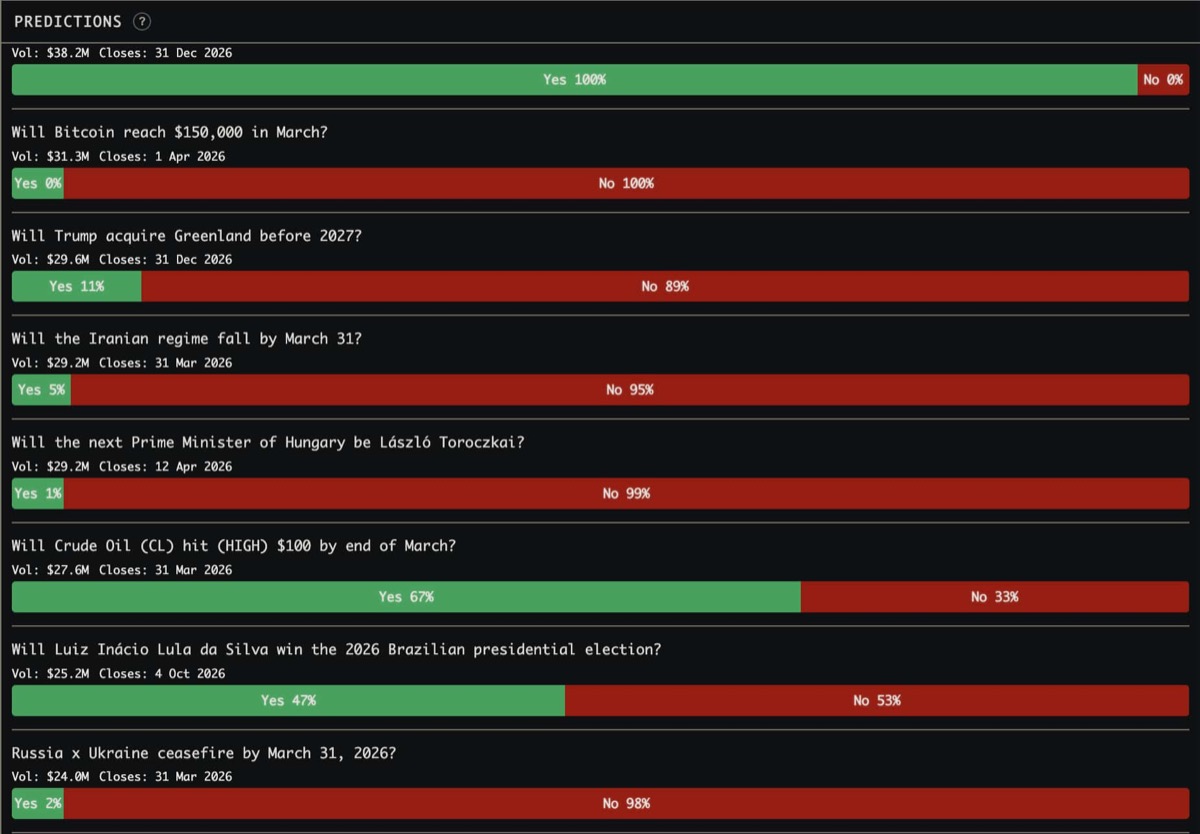
The Predictions panel in the Markets tab shows live contracts from Polymarket and Kalshi:
- The question, such as an election, a policy decision, a ceasefire or a commodity price threshold
- Yes and No probabilities as a bar you can read at a glance
- Trading volume, which tells you how much money stands behind the price
- Closing date, so you know the time horizon
- Source label, so you know which venue the contract comes from
The panel pictured above shows the format: each contract with its volume, closing date and Yes/No split.
Why Prediction Markets Matter to Traders
Prediction markets aggregate the views of people with money at stake, which pushes prices toward calibrated probabilities. For a trader, they are useful in three ways:
- Pricing event risk. If you hold oil, a contract on a Gulf ceasefire tells you how the crowd prices the scenario that would hurt you most.
- Spotting divergence. When the odds say one thing and the signals on the map say another, either the crowd is missing something or you are. Both are worth knowing.
- Tracking direction. A probability moving from low single digits to the teens over a week can matter more than its level.
Treat this as an illustration of the reading process, not a forecast: a headline says talks are resuming, the analysis says prospects are uncertain, and a contract on a deal by year-end trades at a specific percentage with meaningful volume. The number is more actionable than the adjectives, and its movement over time is a signal in itself.
Signals That Move the Odds
The Planet’s value is putting the odds next to the evidence. Before you agree or disagree with a market, you can check:
| Signal | Where to find it | What it adds |
|---|---|---|
| Prediction markets | Markets tab, Predictions | Crowd-priced probability |
| Country Instability Index | Conflicts tab | Quantitative instability and its trend |
| Escalation indicators | Conflicts tab, Escalation Monitor and Force Posture | Physical signs of escalation |
| Theater posture | Intelligence tab, AI Strategic Posture | Military posture across nine theaters |
| Cross-source signals | Intelligence tab | Independent sources converging on an event |
| Raw reporting | Intelligence tab, Telegram Intel and Social Velocity | Fast, unfiltered ground-level reports |
When most of these point the same way, confidence is higher. When they diverge, you have found something to investigate. For the conflict side, see tracking global conflicts in real time.
AI Forecasting With Pro
Pro ($39.99 per month or $399.99 per year) adds AI panels that turn signals into structured forward-looking views:
- AI Forecasts: probability forecasts for geopolitical and market events, updated as new signals arrive
- Deduct Situation: describe a situation and get a deduction of likely next moves, risks and market impact
- AI Analyst: ask about any country, conflict or market and get an answer grounded in live data
- AI Market Implications: cards mapping today’s events to tickers, with direction, timeframe and the risk caveat
- Regional Intelligence: briefs and risk snapshots for each world region
The useful pattern is comparison. If an AI forecast and a prediction market disagree on the same event, look at what each is weighting. If they agree and the physical signals agree too, the scenario deserves more weight in your planning.
Practical Workflows
Macro trader
- Check the Predictions panel for elections, central bank decisions and escalation contracts relevant to your book.
- Compare with the Economic Calendar for scheduled events.
- Check Market Radar, Financial Stress and the Yield Curve for the risk backdrop.
- If a contract moves sharply, look for the driver in the News tab and the Intel Feed.
- Size positions with the event probability in mind, not just the headline.
Commodity trader
- Watch contracts tied to supply: ceasefires, sanctions, export bans and price thresholds.
- Cross-check with Chokepoint Status, the Hormuz Trade Tracker and the Energy Disruptions Log.
- Use the Country Instability Index for producer-country risk.
- See tracking trade routes, chokepoints and freight costs for the shipping side.
Event-driven equity trader
- Track contracts on policy decisions that affect a sector, such as tariffs or regulation.
- With Pro, use AI Market Implications to see which tickers today’s events map to.
- Check Market Breadth and the Sector Heatmap to see whether the market is already reacting.
Limits to Keep in Mind
- Prediction markets are well-calibrated on average but can be wrong on any single question, and thin markets can be moved by small amounts of money.
- AI forecasts are grounded in the data they see and can miss context that is not in that data.
- Instability scores are algorithmic and can lag truly unprecedented events.
- No single signal should drive a trade on its own. Nothing in The Planet is investment advice.
The value is in combining independent signals. For more on how traders use the rest of the app, see real-time market intelligence for traders.
Frequently Asked Questions
Which prediction markets does The Planet show? The Predictions panel shows contracts from Polymarket and Kalshi, with probabilities, trading volume and closing dates.
Are AI forecasts free? The Predictions panel is free. AI Forecasts, Deduct Situation, the AI Analyst and AI Market Implications are part of Pro ($39.99 per month or $399.99 per year).
How accurate are prediction markets for geopolitical events? In aggregate, prediction markets have a strong track record against polls and expert panels because participants have money at stake. Individual contracts can still be wrong, so use them alongside other signals rather than on their own.
See the odds next to the evidence at theplanet.today/app/markets.